


SelfieSign vs. Alternatives — Who Offers the Most Comprehensive E-Signature Solution?

Updated: Jun 4
Quick Overview
Most businesses default to DocuSign, Adobe Sign, or HelloSign and assume compliance is covered. For routine contracts, it usually is. But when a signature gets disputed, the cracks show. All three platforms produce audit trails that live separately from the document itself, and their identity verification is either basic by default or locked behind premium add-ons. SelfieSign takes a different approach. Its video-based signatures are embedded directly into the document, cryptographically sealed, and eIDAS AES-compliant out of the box. Compliant and defensible aren't the same thing — and for high-stakes signing, that difference matters.
What we'll cover

The Playing Field: What the Big Names Actually Offer
Before comparing, it's worth understanding what the mainstream platforms were designed to do.
DocuSign, Adobe Acrobat Sign, HelloSign (now Dropbox Sign), and similar tools were primarily built for convenience. They digitized the paper-signing experience, made it fast, and made it accessible. That's a genuine achievement.
Where they get complicated is in how they handle the higher end of the compliance spectrum.
The EU's eIDAS regulation offers the clearest global framework for understanding these distinctions. It defines three tiers:
Basic Electronic Signature (BES)
This is the baseline. A typed name, a checkbox, or a scanned image qualifies. It's legally valid for low-stakes use cases, but it offers minimal authentication and is easy to challenge.
Advanced Electronic Signature (AES)
This tier requires that the signature be uniquely linked to the signer, capable of identifying them, created using data under their sole control, and capable of detecting any subsequent changes to the document.
Qualified Electronic Signature (QES)
The gold standard. QES carries the same legal weight as a handwritten signature across all EU member states and requires a physical smart card or hardware security device. It's essential for the highest-stakes transactions but comes with implementation friction.
Feature | Basic Electronic Signature (BES) | Advanced Electronic Signature (AES) | Qualified Electronic Signature (QES) |
Legal Effect | Lowest | Higher | Highest |
Security | Lowest | Medium | Highest |
Technical Requirements | Lowest | Medium | Highest |
Application Scenarios | Informal transactions | Most electronic transactions | High-value transactions |
AES is the practical sweet spot for most serious business transactions, whether in financial services, healthcare, real estate, or professional services. It’s rigorous enough to hold up legally, flexible enough to implement without hardware tokens.
Now, the question is not about whether these e-signature tools are "compliant." Most key players in the market can meet eIDAS AES requirements in the right configuration and a little extra $$$. (A topic we'll unpack properly another time.)
The question is what their audit trail looks like when a document is challenged in court.
This is where mainstream platforms show their limits.
The Hidden Problem: What Happens in a Dispute?
Here's something that surprises a lot of people: "electronic signature" is an umbrella term that covers a massive range of security and legal strength.
Think of it like the difference between a sticky note and a notarized document. Both are written, but they carry very different weights.
Real talk? Most of the platforms businesses rely on sit much closer to the sticky note than the notarized document.
DocuSign, Adobe Sign, and HelloSign all produce event-based logs. Their standard audit trails capture key timestamps and the signer's IP address, with some platforms offering more granular detail than others. Through third-party add-ons or premium-locked features, all three also offer biometric ID verification, where signers pass a liveness check and a government ID match before they can proceed to signing.
It sounds robust. But even when this verification is enabled, it's a one-time check at the start of the process. What happens after that check clears? Someone else could sit down and complete the signing, and nothing in the evidence trail would catch it.
This points to a structural problem that all three platforms (along with most e-signature solutions in the market) share.
The identity verification and the document signing are two entirely separate events, never cryptographically bound to each other. The audit trail lives in a completion certificate, a log entry, or an email chain, completely disconnected from the document itself.
In a dispute, a determined counterparty can credibly argue that the evidence doesn't directly correspond to the document version that was actually signed. The signature and the proof of identity are two different artifacts, stored in two different places, with nothing tying them together at a technical level.
That's the gap SelfieSign was built to close.
How SelfieSign Approaches Evidence Differently
SelfieSign's core innovation is its .SVS (Selfie Video Signature) format. Instead of producing a static audit trail after signing is complete, it records the signing session itself and embeds that recording directly into the document, making it inseparable from the file it authenticates.
Each .SVS signature package includes:
Video and audio of the signer throughout the entire signing process
Device fingerprint, IP address, and GPS location, where applicable
A cryptographic timestamp tied to the exact document signed
All of this is embedded inside the document itself, cryptographically sealed so that any tampering with either the document or the video record is immediately detectable.
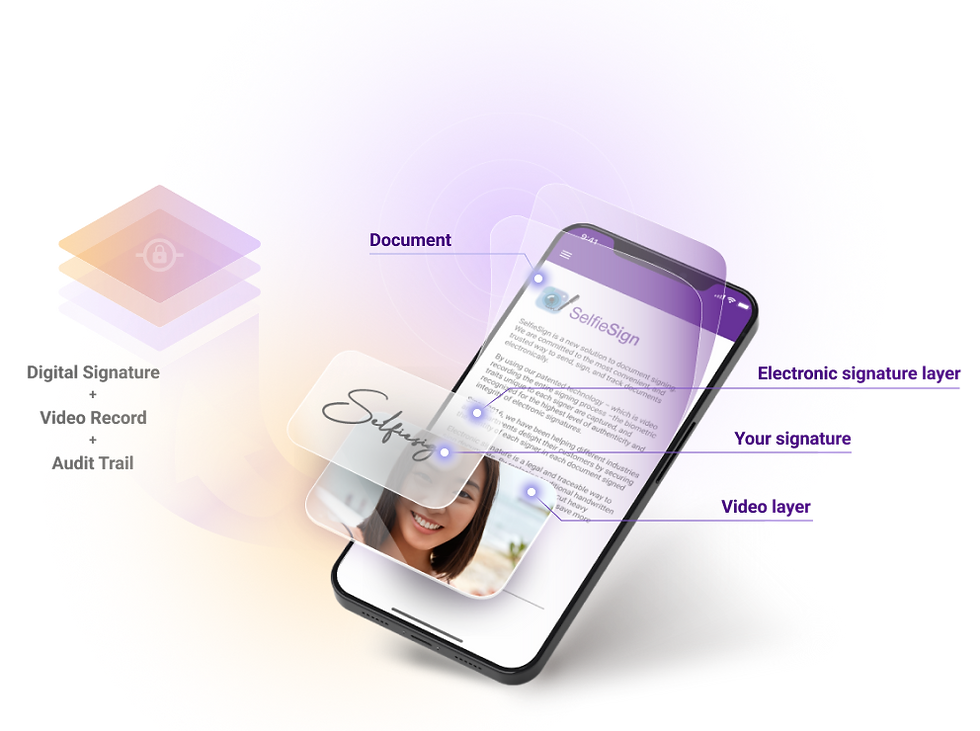
This approach meets eIDAS AES standards natively, not as a paid add-on or through a third-party Trust Service Provider partnership, and stores signatures in both PAdES (PDF Advanced Electronic Signatures) and XAdES (XML Advanced Electronic Signatures) formats. These are internationally recognized standards that ensure the signature remains independently verifiable, without dependence on any vendor's platform.
Identity Verification: A Comparison
DocuSign: Standard plans authenticate signers via email link, SMS, or WhatsApp, none of which confirm identity, only device access. Knowledge-based authentication (a questionnaire generated from the signer's public records) is available but limited to US signers. Advanced ID verification, including government ID scanning and liveness detection, is a separate paid add-on.
Adobe Sign: Basic authentication uses Adobe ID, OTPs, or document passwords. More meaningful options, such as phone verification, government ID scanning, biometric matching, knowledge-based authentication (US only), and cloud-based digital signatures, are premium features that require configuration and add cost per transaction.
HelloSign: Simple to a fault, it uses SMS and password with optional biometric add-ons through third-party integrations. While it works well for low-risk use cases, it works less well for anything else.
SelfieSign: Identity verification isn't a module or an add-on; it's how the product works. The live signing process itself is the identity record. The signer's face, voice, and behavior are captured throughout, with no extra steps, no separate verification flow, and no additional fee.
SelfieSign can support identity assurance up to ISO 29115 Level of Assurance 4 (LoA4), the highest tier in the international standard.
For situations requiring an extra layer of certainty, such as banking, insurance, or government contracting, FaceOTP captures the signer's OTP entry live on video — adding a recorded, time-stamped confirmation of physical presence.
Feature | DocuSign | Adobe Sign | HelloSign | SelfieSign |
Default compliance level | BES | BES | BES | eIDAS AES |
AES/QES availability | Paid add-on | Paid add-on / 3rd party TSP | Enterprise add-on | Native — included |
Identity verification | Paid add-on (IDV) | Premium plans only | Basic - SMS + password verification | Biometric (built-in) + Behavioral |
Evidence type | Static (IP, timestamp) | Static (IP, timestamp) | Static (IP, timestamp) | Dynamic (video + audio + metadata) |
Evidence location | Separate certificate | Separate certificate | Separate certificate | Embedded in the document |
Signature format | PDF (PKI) | PDF (PKI) | PAdES + XAdES + .SVS | |
Post-verification signing gap | Yes — identity and signing are separate events | Yes | Yes | No — signer is recorded throughout |
APAC + EMEA compliance -friendly | No | No | No | Yes |
On-premise deployment | Enterprise only | Enterprise only | No | Yes |
ISO 29115 LoA4 capable | Partial (with add-ons) | Partial (with add-ons) | No | Yes |
A Real-World Test: The Spanish Loan Dispute
Legal standards only reveal their real value under pressure. Here's a case that illustrates what SelfieSign's evidence package looks like in practice.
A lender in Spain used SelfieSign to collect signatures on online loan agreements. When the borrower later challenged the contract, the lender presented a complete video signature record, resolving the dispute in their favor.
This is the difference between a signature that's technically valid and one that's genuinely defensible.
Who Should Be Reconsidering Their Current Platform
DocuSign, Adobe Sign, and other popular e-signature solutions are excellent tools for standard business contracts where signing parties are known, disputes are unlikely, and the priority is workflow speed and ecosystem integration.
If that describes the majority of your use cases, you're probably well-served by either platform.
The calculation changes when:
Your industry is regulated (ex. financial services, healthcare, legal, government procurement, etc.) — where identity verification and audit quality are compliance requirements.
Your contracts cross borders, particularly into the EU, where eIDAS AES compliance needs to be native
High-value disputes are a real possibility, and "we have an IP address" isn't sufficient evidence in the jurisdiction where your contracts are governed.
You operate in the EU, Taiwan, or other Asia-Pacific markets, where regulatory frameworks are stricter and more fragmented than the US-centric baseline most platforms are built around.
You need on-premise deployment — an option many competitors restrict to expensive enterprise tiers.
You handle on-site, in-person signing, a use case most platforms quietly fail at.
Let us explain the last one. When an e-signature is needed from someone who is standing right in front of you, email-based authentication and traditional digital certificates aren't practical in the moment. And at the same time, unlike paper-based signatures, you can’t do handwriting analysis to verify if the signature is ever challenged.
This is why over 90% of Taiwan’s hospitals using e-signatures for patient consent forms chose SelfieSign to prove the signer’s identity.
The Bottom Line
The mainstream e-signature platforms have done a good job of making signing fast and accessible. Where they fall short is in generating evidence that's genuinely built to be challenged and to win.
The pattern across DocuSign, Adobe Sign, HelloSign, and other popular e-signature providers is consistent. Identity verification and high-compliance features are add-ons. Audit trails are external. And the gap between "someone verified their identity" and "that same person completed this signing" is a structural vulnerability that most businesses never notice until it's too late.
SelfieSign starts from the other end. The video evidence, biometric verification, and document-embedded proof aren't features you unlock at a higher price tier. They're how every signature works.
For organizations where legal robustness isn't optional, that difference is the whole game.
Contact us today to discuss your requirements or schedule a demo.
ThinkCloud offers API integration and enterprise deployment options for organizations evaluating SelfieSign alongside their existing tools.
People Also Ask
Is DocuSign eIDAS AES compliant?
DocuSign can meet eIDAS AES requirements, but not on standard plans. Advanced identity verification and higher compliance tiers are available as paid add-ons that require additional configuration and cost.
What is the difference between an Advanced Electronic Signature and a Basic Electronic Signature?
A Basic Electronic Signature is as simple as a typed name or a checkbox. An Advanced Electronic Signature must be uniquely linked to the signer, capable of identifying them, and able to detect any tampering with the signed document. The legal defensibility between the two is significant.
What makes a digital signature legally defensible in court?
Legal defensibility comes down to the quality of evidence. A strong signature record proves who signed, that they intended to sign, and that the document hasn't been altered since. An IP address and a timestamp alone are often insufficient in high-value disputes.
What is eIDAS, and does it apply outside the EU?
eIDAS is the EU's regulatory framework for electronic signatures and digital identity. While it is technically an EU regulation, it has become the global benchmark for signature compliance, and many organizations outside the EU use it as the standard their signing processes are measured against.
Can e-signatures be used for in-person, on-site signing?
Most platforms weren't built for it. Email-based authentication doesn't work when a signer is standing in front of you, and traditional digital certificates aren't practical in the moment. This is a commonly overlooked gap that SelfieSign's dynamic biometric signatures were specifically designed to address.
About SelfieSign
SelfieSign is a dynamic biometric signature platform built for high-stakes agreements. Our patented selfie video signing technology (.SVS) captures face, voice, handwriting, geolocation, IP address, and timestamp at the moment of signing and cryptographically binds it to the document.
Trusted by over 80% of hospitals in Taiwan, processing 3 million documents every month, SelfieSign is fully compliant with eIDAS 2.0 AES, GDPR, and ISO 27001.


Comments