


Why Digital Consent Is the Next Step in Paperless Healthcare

Updated: Jul 27
Quick Overview
As hospitals worldwide push toward paperless operations, one process has lagged behind: the consent form. Paper signatures fall short on both compliance and legal defensibility, and cloud-based platforms like SelfieSign are closing that gap. Taiwan's regulatory reforms offer a case study in what it takes for hospitals of every size, not just large medical centers, to make digital consent practical.
What we'll cover
Healthcare is going paperless, and it's happening faster than most people realize.
Sustainability mandates, tightening ESG reporting requirements, and a general reckoning with resource waste are accelerating this transition.
But the shift is about more than sustainability alone.
Rising administrative costs, operational efficiency, and stricter compliance requirements are pushing hospitals to rethink processes that have remained largely unchanged for decades.

One of the biggest holdouts is the consent form.
Even as medical records have moved to the cloud, the actual moment a patient agrees to treatment often still comes down to pen, paper, and a filing cabinet.
That's starting to change, as regulators in various countries loosen restrictions on cloud-based record-keeping and digital signatures for healthcare.
Taiwan offers a useful case study of how regulatory reform can accelerate digital transformation in healthcare. Its Ministry of Health amended national EMR regulations in 2022 to explicitly allow hospitals to store consent forms digitally and use public cloud infrastructure, a shift that's already reshaping how its hospitals operate.
Why Paper Consent Is Becoming a Liability
Informed Consent is one of the oldest principles in medicine.
Before any procedure, a physician has to walk the patient through what's about to happen, why, what could go wrong, and what the alternatives are. The patient's signature is supposed to confirm that they understood all of it and agreed to move forward.
For decades, that confirmation has taken the form of a paper document.
That paper trail comes at a cost.
Every form has to be printed, filed, stored, and retrieved on demand, sometimes years later.
Multiply that across thousands of patients a year, and hospitals end up sinking real staff time and real square footage into paperwork instead of patient care.
And storage isn't even the biggest risk. Signed consent forms still end up at the center of malpractice disputes all the time.
Patients claim they weren't fully informed, that they were too impaired or too overwhelmed to understand what they were agreeing to, or that they simply couldn't read the fine print.
A signature alone can't settle any of that. It proves someone signed something, not that they understood it, and that gap leaves hospitals and physicians with surprisingly little to stand on when a case goes to court.
Paper simply wasn't built to capture context. What hospitals need now is a way to preserve the whole picture: not just that a signature exists, but who signed, when, where, and under what circumstances.
That kind of record can be the difference between a quick resolution and a drawn-out legal battle if a dispute surfaces months or years down the line. Taiwan's health authorities have been pushing toward electronic records since the early 2000s, and adoption is now nearly universal across the country's hospitals. But for years, the rules only covered medical records themselves. Consent forms sat in a legal gray zone: nobody had explicitly said hospitals could digitize them, so most didn't.
It took a dedicated research push starting in 2015, followed by regulatory amendments recognizing consent forms as a legitimate category of electronic medical record, to address the ambiguity.
A Better Way to Capture Informed Consent
One tool purpose-built for digital medical consent is SelfieSign, from ThinkCloud Technology. Instead of just capturing a signature, it records the entire signing process on video in real-time. Rather than treating the signature as the only evidence, it preserves the surrounding context of the signing event, including the signer's biometric data, timestamp, location, device ID, IP address, and cryptographic hash, creating a far more complete and transparent record.
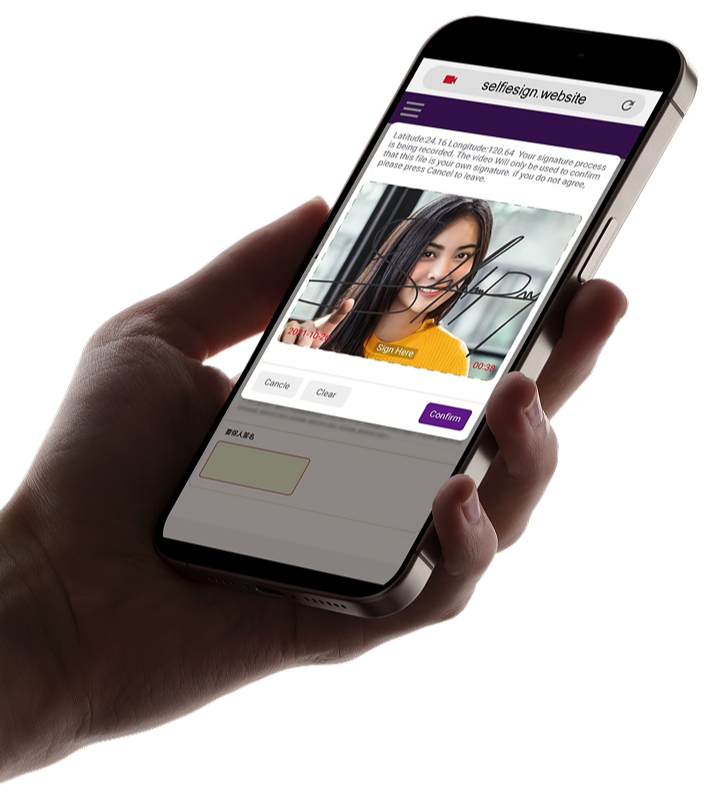
That additional context gives hospitals a record that's much harder to dispute later, protecting both the patient and the provider.
It's already caught on widely in Taiwan. SelfieSign is used across roughly 70% of the country's major medical centers, covering more than 80,000 hospital beds.
China Medical University Hospital is a good example of what that looks like at scale. The hospital processes over 200,000 signed documents a month through the platform, and reports saving around NT$13 million in labor costs and NT$18 million in paper costs every year.
That performance earned SelfieSign two national honors: the Paperless Promotion Award and the Innovative Application Services Award, both from Taiwan's health ministry.
Getting here wasn't easy, though.
Before cloud-based systems were allowed, hospitals wanting to go digital had to build everything themselves: private servers, hospital-wide Wi-Fi, and hundreds or even thousands of tablets and signing devices, all installed and maintained on-site.
Large hospital systems could usually absorb that kind of upfront investment. Smaller regional hospitals, community clinics, and private practices generally couldn't.
That's a real problem, because those smaller providers are often the first place patients actually show up.
Making cloud-based consent tools affordable and accessible for them isn't a nice-to-have. It's what makes paperless healthcare work at scale rather than just at the top end.
As more regulators follow Taiwan's lead in opening the door to cloud-based healthcare, tools like this are likely to become less of a differentiator and more of a baseline expectation, especially for the smaller providers who stand to gain the most.
The Cloud Finally Catches Up
Regulatory change is part of what's making this shift possible.
In Taiwan, recent amendments to national electronic medical record rules loosened restrictions that once made cloud adoption difficult for hospitals.
Healthcare institutions can now outsource the deployment and management of their electronic record systems to qualified outside organizations and adopt cloud services directly, as long as they meet the required security and privacy standards.
These changes weren't driven by carbon goals alone. They also reflect how far cloud computing itself has come.
Advances in cloud infrastructure, encryption, and Software-as-a-Service (SaaS) delivery have made it possible for hospitals to access enterprise-grade systems with lower upfront costs, no dedicated hardware to maintain, and the ability to scale up or down as needed.
What was once practical only for large medical centers is now within reach of hospitals and clinics of every size.
Digital Consent Without Rebuilding Your Hospital
ThinkCloud built its Healthcare Consent Cloud specifically to make this transition practical.
Built on SelfieSign's SaaS platform, it integrates with virtually any Hospital Information System (HIS), allowing hospitals to digitize consent workflows without replacing their existing systems.
Document management, encryption, remote signing, and storage are handled through the cloud, while staff continue working within the workflows they already know.
In practice, it works like this. A physician selects the right consent form inside the HIS, and the system generates a secure signing link. That link can go out by email, text message, or QR code, whatever's most convenient.
There's no app to download. The patient just opens the link in a browser and signs using whatever device they already have on hand: a phone, tablet, or computer with a front-facing camera.
That flexibility matters most when someone can't physically be in the room. A family member consenting on a patient's behalf from another city, an emergency where time is short, or a relative who lives overseas. In all of these cases, SelfieSign still records the full signing session and securely preserves it alongside the consent document, creating the same verifiable record as an in-person signing.
Because the platform manages document storage, encryption, and infrastructure in the cloud, hospitals avoid the cost of building server rooms, deploying campus-wide Wi-Fi, or purchasing large fleets of signing devices.
ThinkCloud handles system maintenance, security updates, and infrastructure management on its end, so hospital staff can spend their time on patient care instead of IT upkeep.
Hospitals simply subscribe based on the number of documents they process, making digital consent accessible to everyone from large medical centers to private practices.
The Economics of Going Paperless
Paper has served healthcare for centuries, but the digital era makes its limitations harder to justify.
Rising raw material costs have only made the burden heavier. Taiwan saw paper prices climb by roughly 5 to 10% in just a few months in 2022, and globally paper prices have only continued to rise through 2026.
For a single large hospital processing around 200,000 consent forms a month, that's roughly 1.6 million sheets of paper, along with the printing, filing, storage, and retrieval costs that come with them.
There's an environmental toll too, one that rarely makes it onto a balance sheet. Paper production at that volume carries a heavy carbon footprint. Going digital cuts it sharply while giving hospitals measurable ESG data instead of vague sustainability claims.
Taiwan's health ministry estimated in 2015 that electronic medical records alone could save a large hospital the equivalent of six Taipei 101 towers' worth of paper every year. Cloud-based digital consent extends those savings even further.
The bigger picture is simple. Digital consent frees up staff time, lowers operating costs, reduces legal risk, and improves patient experience, all while producing stronger, more defensible records of informed consent.
Hospitals that make this shift aren't just cutting costs. They're building a healthcare system that's more efficient, more sustainable, and more trustworthy by design.
People Also Ask
Can electronic consent integrate with existing Hospital Information Systems (HIS)?
Yes. SelfieSign's Healthcare Consent Cloud is designed to integrate with existing Hospital Information Systems through APIs, allowing hospitals to digitize consent workflows without replacing their current infrastructure or disrupting clinical operations.
How can digital consent reduce administrative costs?
Digital consent eliminates paper-based printing, filing, storage, and manual document retrieval while reducing the need for on-premises infrastructure. By streamlining document management and automating workflows, healthcare providers can save time, lower operational costs, and free up staff to focus on patient care.
Can patients or family members sign remotely?
Yes. Patients or authorized family members can securely review and sign consent forms from anywhere using a smartphone, tablet, or computer. No app installation is required, making it easier to obtain informed consent when relatives cannot be physically present at the hospital.
Is digital consent secure enough for healthcare?
Modern consent platforms like SelfieSign are built with encryption, secure authentication, audit trails, and compliance with recognized electronic signature standards. When implemented correctly, they can meet the stringent privacy, security, and legal requirements expected in healthcare environments.
Which healthcare organizations benefit most from digital consent?
Digital consent benefits organizations of every size—from large medical centers processing hundreds of thousands of documents each month to regional hospitals, specialty clinics, and private practices. Any healthcare provider looking to reduce paper, improve operational efficiency, strengthen compliance, and create more defensible consent records can benefit from adopting a digital consent platform.
About SelfieSign
SelfieSign is a dynamic biometric signature platform built for high-stakes agreements. Our patented selfie video signing technology (.SVS) captures face, voice, handwriting, geolocation, IP address, and timestamp at the moment of signing and cryptographically binds it to the document.
Trusted by over 80% of hospitals in Taiwan, processing 3 million documents every month, SelfieSign is fully compliant with eIDAS 2.0 AES, GDPR, and ISO 27001.


Comments